• About
    • AnaEE in a nutshell
    • Our network
    • Our team
    • Jobs
    • Governance
    • Become a Member
  • Services
    • Services
      • Service Overview
      • Facility Catalogue >
      • AnaEE & API >
    • Apply and access
    • Open Calls
    • Partnership
  • Science & Impact
    • Success Stories
    • Publications
    • EU Projects
  • News & Resources
    • News & Events
      • News
      • Event calendar
      • AnaEE Webinars
      • AnaEE Conference 26
    • Documents
      • All Documents
      • Media Centre
      • Governance Documents
  • Contact

Scientific Publications

Paper: Research infrastructures as engines of integration for micro- and nanomaterial research

September 7, 2026

A new paper from FHERITALE has been published this week in Food Safety and Risk! Drawing on…

Read More about Paper: Research infrastructures as engines of integration for micro- and nanomaterial research

New AnaEE publication: How frequently should we measure greenhouse gas emissions from lakes?

May 26, 2026

New insights from the Silkeborg Aquatic Facility Freshwater ecosystems are among the most significant yet underestimated sources…

Read More about New AnaEE publication: How frequently should we measure greenhouse gas emissions from lakes?

New AnaEE publication in Science: Plants’ climate change adaptation

March 27, 2026

Can Plants Evolve Fast Enough to Survive Climate Change? New research supported by AnaEE-France offers both hope…

Read More about New AnaEE publication in Science: Plants’ climate change adaptation

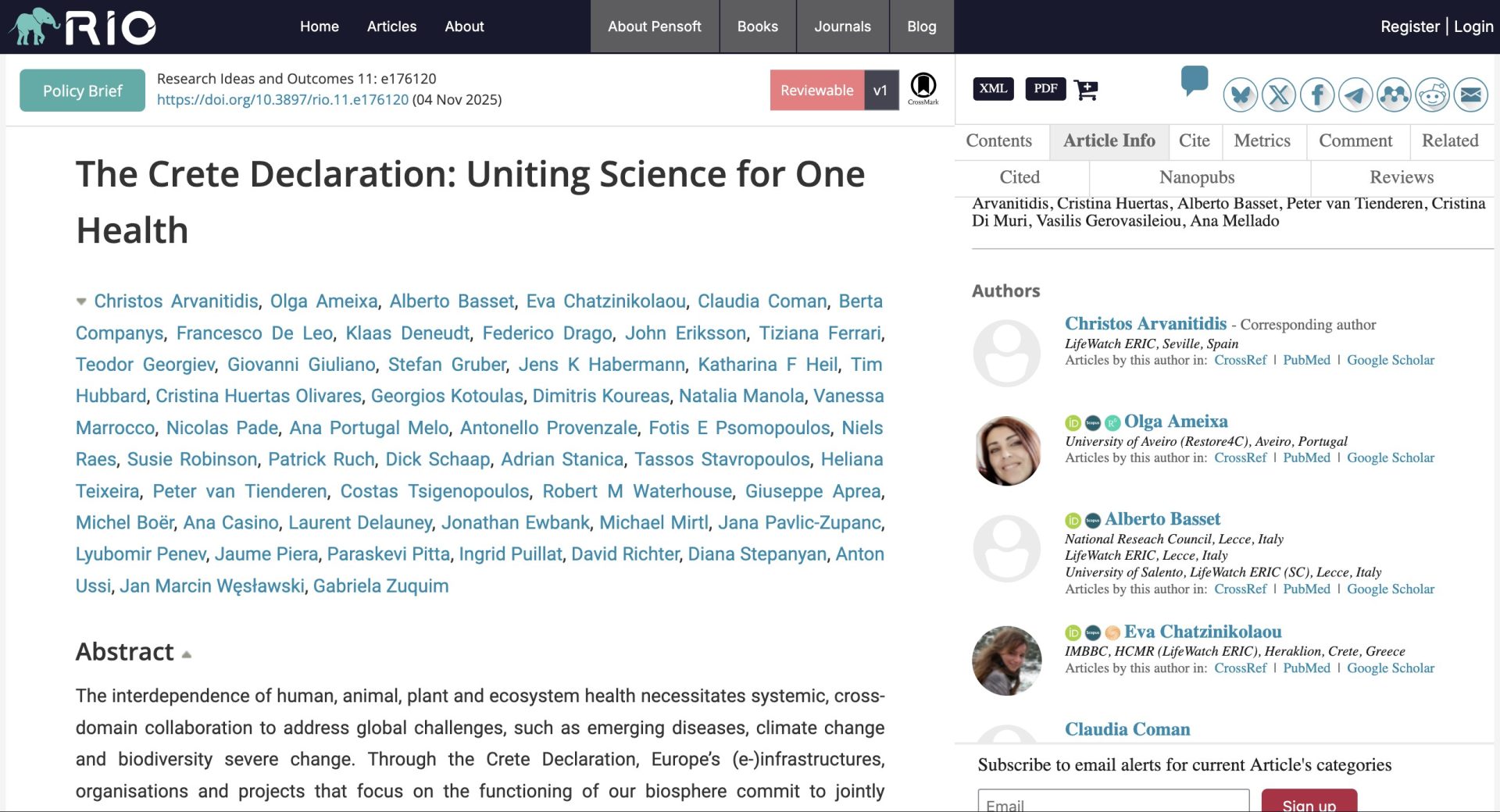
AnaEE-ERIC Contributes to Landmark Crete Declaration for World Science Day

November 10, 2025

On World Science Day for Peace and Development, AnaEE-ERIC proudly announces its contribution to the Crete Declaration,…

Read More about AnaEE-ERIC Contributes to Landmark Crete Declaration for World Science Day

The added value of including key microbial traits to determine nitrogen-related ecosystem services in managed grasslands

October 29, 2025

Thomas Pommier, Amélie A. M. Cantarel, Karl Grigulis, Sandra Lavorel, Nicolas Legay, Catherine Baxendale, Richard D. Bardgett, Michael Bahn, Franck Poly, Jean-Christophe Clément First published: 13…

Read More about The added value of including key microbial traits to determine nitrogen-related ecosystem services in managed grasslands

Towards understanding the impact of mycorrhizal fungal environments on the functioning of terrestrial ecosystems

January 11, 2025

Olivier Nouwen, Francois Rineau, Petr Kohout, Petr Baldrian, Nico Eisenhauer, Natalie Beenaerts, Sofie Thijs, Jaco Vangronsveld, Nadejda…

Read More about Towards understanding the impact of mycorrhizal fungal environments on the functioning of terrestrial ecosystems

Microbial and bryospheric photosynthesis of boreal peatlands have peatland-type-specific responses to long-term drying

January 11, 2025

Olivia Kuuri-Riutta, Marie Le Geay, Vincent E. J. Jassey, Janna M. Barel, Anna M. Laine, Henni Ylänne, Eeva-Stiina Tuittila https://doi.org/10.1111/nph.70519 Summary The impacts…

Read More about Microbial and bryospheric photosynthesis of boreal peatlands have peatland-type-specific responses to long-term drying

Validating the Carnegie-Ames-Stanford Approach for remote sensing of perennial grass net primary production

January 11, 2025

Shaohui Zhang , Poul Erik Lærke , Mathias Neumann Andersen , Junxiang Peng , Esben Øster Mortensen…

Read More about Validating the Carnegie-Ames-Stanford Approach for remote sensing of perennial grass net primary production

Litter biomass as a driver of soil VOC fluxes in a Mediterranean forest

January 11, 2025

https://doi.org/10.5194/egusphere-2025-54 Manon Rocco,Julien Kammer,Mathieu Santonja,Brice Temime-Roussel,Cassandra Saignol,Caroline Lecareux,Etienne Quivet,Henri Wortham,and Elena Ormeno Abstract. Soil biogenic volatile organic…

Read More about Litter biomass as a driver of soil VOC fluxes in a Mediterranean forest

Litter leaves misrepresent plant–insect interactions in standing vegetation

January 11, 2025

Benjamin Adroit Sandra R. Schachat H. Tuncay Güner Jean-Philippe Orts Thomas Denk Front. Ecol. Evol., 18 September…

Read More about Litter leaves misrepresent plant–insect interactions in standing vegetation
1 2 Next

Quick Links

Home
About Us
Events
Contact
Members Page (login)

Contact info

AnaEE-ERIC – Central Hub
1 avenue de la Terrasse
91190 Gif-sur-Yvette
AnaEE Science
Conference

Other

Legal Notices
FAQ
LS-RI
ENVRI

Newsletter

Subscribe to our newsletter for funding opportunities, publications, events and other ecology research news.

SUBSCRIBE
  • Bluesky
  • LinkedIn
  • YouTube
  • Mail

Copyright © 2025. All rights reserved.

List of AnaEE member universities/institutes

Our network brings together leading research institutions, universities, and organizations from across Europe, united by a shared commitment to advancing ecosystem science. Each member contributes unique expertise, facilities, and perspectives, creating a powerful collective capability that no single institution could achieve alone.

  • Belgium: University of Antwerp, University of Hasselt, University of Liége
  • Bulgaria: Institute of Soil Science “Nikola Poushkarov”
  • CIHEAM
  • Czech Republic: Czech Globe
  • Denmark: University of Aarhus, University of Copenhagen, Roskilde university, Technical University of Denmark
  • Finland: University of eastern Finland, University of Helsinki, University of Turku, University of Oulu, Natural Resources Institute Finland
  • France: Université Paris Sciences et Lettres, Ecole normale supérieure, CNRS, Université de Rennes, Université Grenoble alpes
  • Italy: Italian National Research Council (CNR), CREA

What is TNA?

Transnational Access (TNA) is a funding program that lets researchers from one country use specialized research facilities, equipment, or resources located in another country – usually for free or at reduced cost.


How it works: Think of it like a library card system, but for expensive scientific equipment. A researcher in Spain might need to use a specialized telescope in Chile, or a particle accelerator in Switzerland, or a rare biological collection in Germany. TNA programs cover the costs so researchers can access these facilities they couldn’t otherwise afford.


Key points:

  • Who pays: Usually funded by the EU or other international research organizations
  • What’s covered: Travel, accommodation, and access to the facility/equipment
  • The goal: Share expensive infrastructure across borders so science advances faster and more equitably
  • Who benefits: Researchers who don’t have access to specialized equipment in their home country


Example: A marine biologist in Poland wants to study deep-sea creatures but doesn’t have access to a research vessel. Through TNA, they could apply to use a marine research station in Norway, with costs covered by the program.

It’s essentially about democratizing access to world-class research infrastructure and promoting international scientific collaboration. Several of our projects offer TNA funding, explore them in the links below.