Can Plants Evolve Fast Enough to Survive Climate Change?
New research supported by AnaEE-France offers both hope and a warning.
A landmark international study published in Science on March 26, 2026 has shed new light on one of ecology’s most urgent questions: can plant populations evolve quickly enough to keep pace with a rapidly warming world?
The answer, it turns out, is nuanced — and the details matter for the future of biodiversity.
A Global Experiment in Evolution
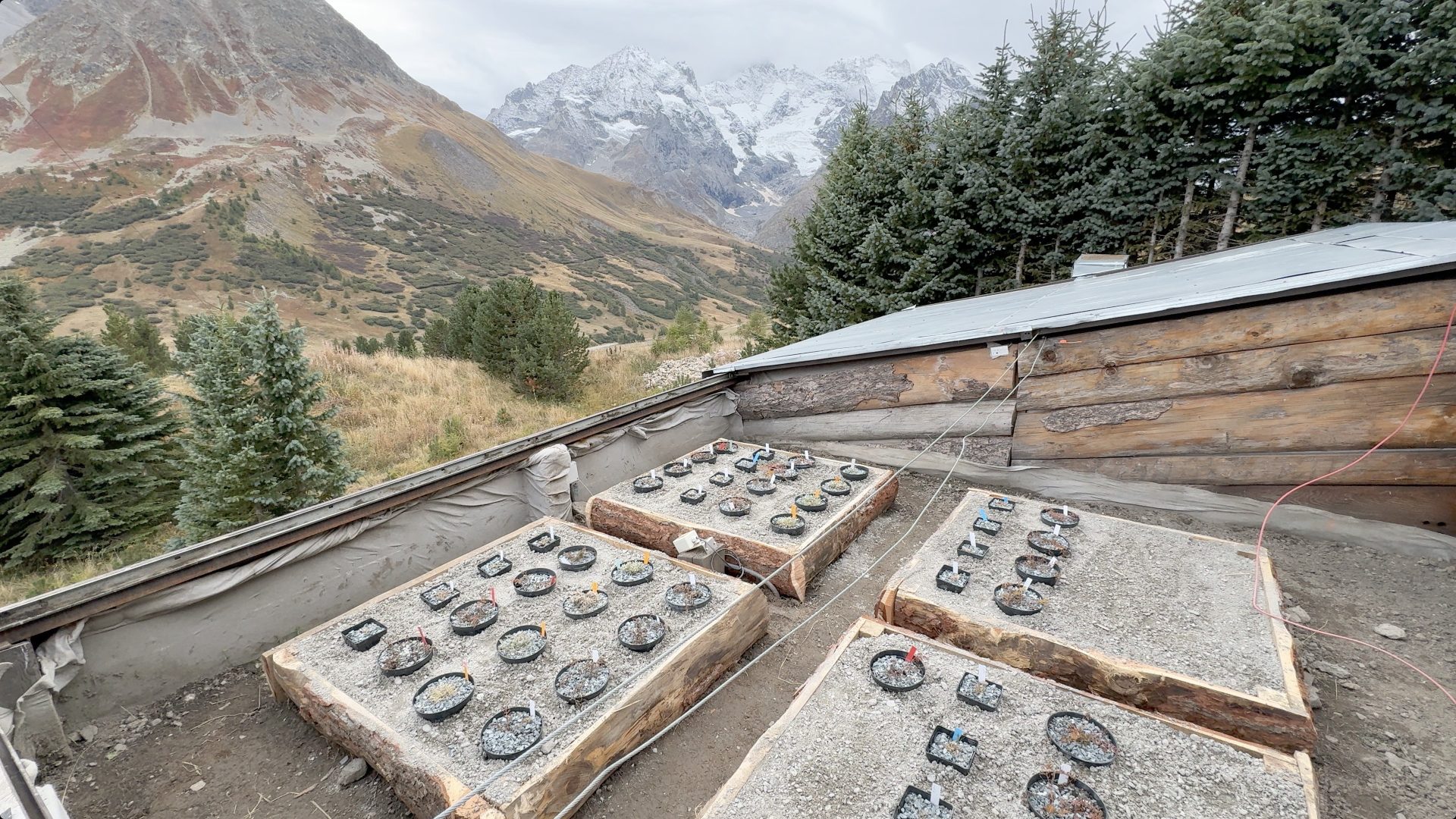
The GrENE-net consortium — co-led by researchers from the University of California Berkeley, the University of Frankfurt, and CNRS France — sowed 3.5 million seeds of Arabidopsis thaliana across 30 sites spanning three continents, from the snow-covered Col du Lautaret in the French Alps to the Negev Desert in Israel. Over three years, they tracked how these populations evolved in real time, sequencing the genomes of approximately 70,000 surviving plants.
The scale and ambition of the experiment is unprecedented. Rather than observing evolution after the fact, scientists were able to watch genetic change unfold simultaneously across radically different climates.
What the Study Found
The results reveal four key insights:
- Rapid adaptation is possible. Plant populations were able to evolve meaningful genetic changes within just three generations — a remarkably short timescale by evolutionary standards.
- Genetic diversity is a critical asset. Populations that carried greater genetic variation were better equipped to survive and adapt to new climatic conditions.
- The more evolutionary “raw material” a population has, the greater its chances of producing individuals suited to a changing environment.
- The same variants win, everywhere. Across all sites, researchers observed that the same genetic variants were independently selected under similar climatic conditions — demonstrating that the evolutionary response to climate is predictable and reproducible.
But there are hard limits. In the hottest environments — precisely those expected to expand under climate change — selection pressure became so extreme that it exceeded the populations’ adaptive potential. Scientists term these “eco-evolutionary tipping points”: thresholds beyond which evolution simply cannot keep up.
The Role of AnaEE Infrastructure
AnaEE-France, part of the AnaEE-ERIC pan-European research infrastructure, provided key ecosystem experimentation facilities that contributed to making this large-scale, long-term study possible. The Lautaret Garden (Université Grenoble Alpes / CNRS), one of AnaEE-France’s flagship sites, hosted one of the 30 experimental plots — offering the controlled alpine environment essential to the study’s design.
This kind of research exemplifies what AnaEE’s network of experimental platforms is built for: enabling scientists to conduct replicated, multi-site, long-term ecosystem experiments that would be impossible to carry out in isolation.
Reference: GrENE-net consortium, Science, March 2026. French teams: CEFE Montpellier (CNRS), GEOLAB Clermont-Auvergne (CNRS), Lautaret Garden (UGA/CNRS). Supported by AnaEE-France (ANR-11-INBS-0001).
Paper in the Spotlight: Rapid adaptation and extinction in synchronized outdoor evolution experiments of Arabidopsis
Xing Wu, Tatiana Bellagio, Yunru Peng, Lucas Czech et al., 2026.
Science, Vol. 391, Issue 6792.
https://doi.org/10.1126/science.adz0777
Watch the facility in our video.