AnaEE-ERIC operates four specialised centres that provide comprehensive support to its members and users across experimental infrastructure, data management, modelling, and training. The Infrastructure Centre coordinates access to experimental facilities and ensures quality standards; the Data Centre manages data storage, curation, and accessibility; the Modelling Centre supports integration of experimental data with computational models; and the Training Centre delivers capacity building through workshops, educational programs, and knowledge exchange activities.
For open positions, go to our Jobs page or check out recruitment news.
Michel’s distinguished career spans astrophysics, gravitational wave research, and experimental ecology, reflecting expertise in leading innovative projects and intergovernmental organizations.
Michel Boër
Director General Central Hub
Mireille has a various background in int. relations, economy, development policies and public administration. She uses her expertise in management, law and finances to foster the development of the organisation.
Mireille Matene
Chief Admin. & Financial Officer Central Hub
Biljana has a background in plant biotechnology, plant physiology, and the effects of biotic and abiotic stress on plant growth, with over 15 years of experience managing and conducting advanced research projects.
Biljana Đorđević
Scientific Officer Interface & Synthesis Centre
With a Ph.D. in Energy and Environmental Engineering, Adriano developed expertise in biomass valorization and remote sensing, focusing on emissions from bioenergy systems and geospatial analysis for ecosystem monitoring. He collaborates on data services and modeling tools.
Adriano Palma
Data & Modelling Scientist Data & Modelling Centre
Rachel has a background in environmental research, with a primary focus on greenhouse gas measurements. At AnaEE she establishes standardised protocols and harmonised workflows for ecological measurements.
Rachel Burns
Scientific Officer Technology Centre
Dorra has a Ph.D. in environmental science with expertise in biological pollutants, their links to climate, vegetation, and human health. Her responsibilities helps researchers to access AnaEE facilities, allocation, compliance and user support across transnational facilities.
Dorra Gharbi
Central Access Manager & Operations Officer Central Hub
Amanda has a background as an investigative journalist, studied documentaries and storytelling is close to her heart. She will bring your science to life in close collaboration with the network members.
Amanda Ölander
Senior Communications Officer Central Hub
Janko holds a Ph.D. in Forest Ecology and brings many years of research experience in ecophysiology, focusing on forest ecosystem responses to environmental change. He works wih project development and stakeholders to align with ecological research and policy objectives.
Janko Arsić
EU Proj. Manager & Liaison Officer Interface & Synthesis Centre
With a Ph.D. in atmospheric chemistry and experience in strategy consulting and startup leadership, the focus is on advancing impactful environmental projects. He collaborates with experts on Horizon Europe projects and supports critical research and policy development in environmental science.
Joseph Timkovsky
Science Project Manager Central Hub
Véronique provides the company with her several years of experience in organizational and administrative functions to furnish and maintain the premises, organise Management Board meetings across Europe, and teambuilding events for the well-being of employees.
Véronique Ozier-Lafontaine
Office Manager Central Hub
Sarah holds a multidisciplinary academic background in law, international relations, and management. As the Project Manager for AgroServ, Sarah leverages her expertise to support innovative and sustainable solutions in the agroecology sector.
Sarah Dramé
EU project Manager Central Hub
With a background in Political Science and Int. Studies, Daniele holds a Master’s degree in Urban Planning. He has experience in research, communications, event production, and project development. With AgroServ he is the communications officer.
Daniele Baldo
Communications Officer, AgroServ Central Hub
At AnaEE Youssef works with software development and user needs analysis, contributing to a comprehensive service catalogue that enhances access to providers and services for the EU-projects IRISCC & M4C.
Youssef Haidla
IT-Engineer Central Hub
Ly has experience in computational simulation and analysis in physics and biophysics research. As a postdoc. researcher with PHENET, her focus is on computational modeling and environmental data analysis for ecosystem resilience and environmental variability.
Thi Ly Mai
Postdoctoral Researcher Central Hub
Work with us
Join our dynamic team
AnaEE-ERIC is an equal opportunity employer. As an organization it promotes equal opportunities and diversity. The only way to achieve scientific excellence is by considering every person on the basis of merit, ability, competences, and qualification. AnaEE-ERIC promotes respect, dignity and fair treatment for all and it will not tolerate discrimination or any kind of harassment, abuse of power and violence. AnaEE-ERIC will not tolerate any discrimination on whatever basis, origin, gender, sexual orientation, belief, etc.
At AnaEE-ERIC, scientific excellence starts with people. We recruit on merit, champion diversity, and invest in every team member’s growth.
AnaEE-ERIC is an equal opportunity employer. As an organization it promotes equal opportunities and diversity. The only way to achieve scientific excellence is by considering every person on the basis of merit, ability, competences, and qualification. AnaEE-ERIC promotes respect, dignity and fair treatment for all and it will not tolerate discrimination or any kind of harassment, abuse of power and violence. AnaEE-ERIC will not tolerate any discrimination on whatever basis, origin, gender, sexual orientation, belief, etc. AnaEE-ERIC strives for a gender balance in its positions of students, staff, and key personnel. User proposals will be treated to avoid biases based on gender or personality, according to the best practices. Female candidates will be promoted for all new positions established or funded by AnaEE-ERIC. Staff members, including in-kind personnel, are recruited on a competitive basis according to the principle enunciated above.
In order to maintain the excellence of its services, AnaEE-ERIC has a strong policy for capacity building and talent attraction. This means attractive packages, opportunities for training, leadership for EU projects. Each staff will meet the Director General yearly, and its direct supervisor in between (heads of SCs) to precise the key activity areas, the objectives and tasks. A development and training plan will be designed for each employee. We consider that young scientists will be in positions to start a strong, original research program, that will allow them insertion in the community, and be hired elsewhere. They will be also in position to establish a strong network with the community of users (either scientists and industry) that will help them for the future.
Some of them will also be able either to join the industry, or to found a start-up company for the spinoff of the AnaEE products that they will have contributed to build. In that respect, AnaEE will consider carefully the possibility of industry/public funding schemes for PhD students, such as the CIFRE in France, the industrial PhD program in Denmark, or the appropriate schemes in other countries.
For AnaEE, no need to say that this will be a tool to build a community of scientists, engineers, and business founders, that will be invaluable for the long-term sustainability of AnaEE, and warrants the evolution of its scientific objectives and performance.
To provide the best experiences, we use technologies like cookies to store and/or access device information. Consenting to these technologies will allow us to process data such as browsing behavior or unique IDs on this site. Not consenting or withdrawing consent, may adversely affect certain features and functions.
Functional
Always active
The technical storage or access is strictly necessary for the legitimate purpose of enabling the use of a specific service explicitly requested by the subscriber or user, or for the sole purpose of carrying out the transmission of a communication over an electronic communications network.
Preferences
The technical storage or access is necessary for the legitimate purpose of storing preferences that are not requested by the subscriber or user.
Statistics
The technical storage or access that is used exclusively for statistical purposes.The technical storage or access that is used exclusively for anonymous statistical purposes. Without a subpoena, voluntary compliance on the part of your Internet Service Provider, or additional records from a third party, information stored or retrieved for this purpose alone cannot usually be used to identify you.
Marketing
The technical storage or access is required to create user profiles to send advertising, or to track the user on a website or across several websites for similar marketing purposes.
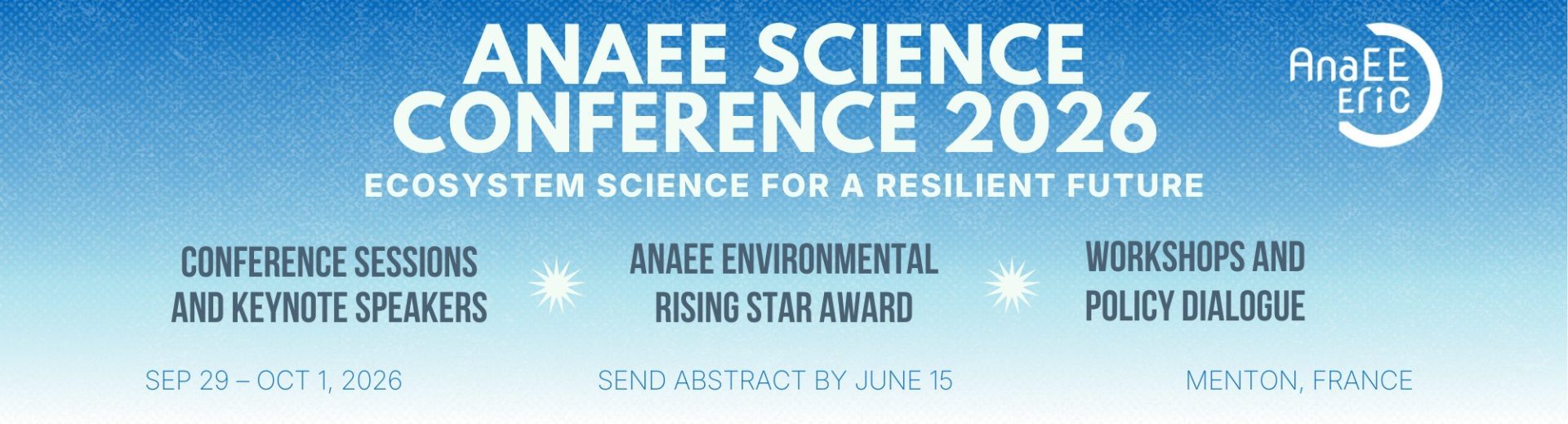
AnaEE-ERIC’s 2nd International Science Conference brings together researchers and policymakers to tackle critical ecosystem challenges through 7 thematic sessions featuring distinguished speakers listed below. The conference spans experimental approaches to global change ecology, forest and agricultural resilience, aquatic-terrestrial interactions, and innovative data integration methods.
Our network brings together leading research institutions, universities, and organizations from across Europe, united by a shared commitment to advancing ecosystem science. Each member contributes unique expertise, facilities, and perspectives, creating a powerful collective capability that no single institution could achieve alone.
Belgium: University of Antwerp, University of Hasselt, University of Liége
Bulgaria: Institute of Soil Science “Nikola Poushkarov”
CIHEAM
Czech Republic: Czech Globe
Denmark: University of Aarhus, University of Copenhagen, Roskilde university, Technical University of Denmark
Finland: University of eastern Finland, University of Helsinki, University of Turku, University of Oulu, Natural Resources Institute Finland
France: Université Paris Sciences et Lettres, Ecole normale supérieure, CNRS, Université de Rennes, Université Grenoble alpes
Italy: Italian National Research Council (CNR), CREA
What is TNA?
Transnational Access (TNA) is a funding program that lets researchers from one country use specialized research facilities, equipment, or resources located in another country – usually for free or at reduced cost.
How it works: Think of it like a library card system, but for expensive scientific equipment. A researcher in Spain might need to use a specialized telescope in Chile, or a particle accelerator in Switzerland, or a rare biological collection in Germany. TNA programs cover the costs so researchers can access these facilities they couldn’t otherwise afford.
Key points:
Who pays: Usually funded by the EU or other international research organizations
What’s covered: Travel, accommodation, and access to the facility/equipment
The goal: Share expensive infrastructure across borders so science advances faster and more equitably
Who benefits: Researchers who don’t have access to specialized equipment in their home country
Example: A marine biologist in Poland wants to study deep-sea creatures but doesn’t have access to a research vessel. Through TNA, they could apply to use a marine research station in Norway, with costs covered by the program.
It’s essentially about democratizing access to world-class research infrastructure and promoting international scientific collaboration. Several of our projects offer TNA funding, explore them in the links below.